
Driving farm profitability, one trial at a time
Imagine measuring the performance of 24,000 different paddocks every year.
This is what makes up the day job of Agricom's five national agronomists.
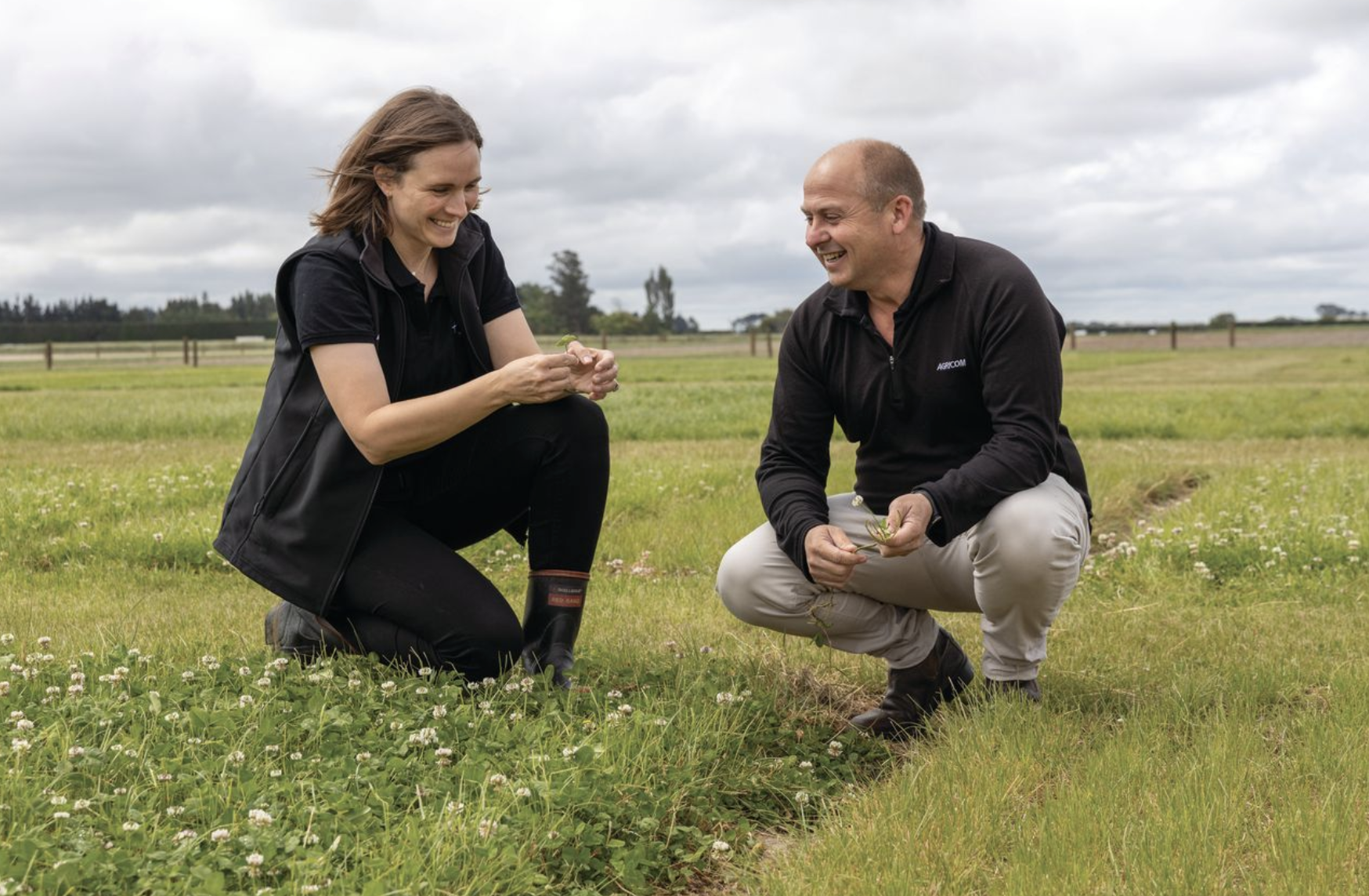
Across 91 trials nationwide, 24,000 plots are harvested annually by an Agricom agronomist and resultant samples are dried down in ovens to provide a dry matter percentage from which kgDM/ha can be worked out. Other recordings include persistence scores, periodic quality analysis and disease scoring and, if the trial is grazed, pulling scores.
Each plot can be viewed as a tiny, replicated paddock covering different regions, soil types and climates.
It's this hands-on investment from Agricom that generates confidence in our products and helps our team recommend them in the most effective way to meet farm system needs.
Agricom's trial systems are run to a very high standard.
While much of our focus is on fully replicated and measured trials that provide reliable outcomes and accurate messaging, our work extends through to large-scale demonstrations (often replicated) not for intensive measurement but to collect observations and interactions with insects and animal grazing.
Five regional agronomists drive this programme, supported by a further five people providing expertise in project management, technical support, and extension in product performance and farm systems fit.
This significant investment by Agricom is seen as a major value proposition for farmers seeking consistent results from Agricom's product range.
From alternative species trials in Northland, endophyte trials in the Waikato, and lamb finishing trials in Manawatū and Hawke's Bay, to dryland research in Canterbury and winter feed insights from Southland, we cover all of New Zealand with our wide and varied research effort.
The results not only support seed resellers and farmers themselves, but can advance industry knowledge and understanding of the potential of plant breeding in NZ forage systems.
One extensive piece of work, for example, that has highlighted the power of clovers and the importance of genetic gain in clover breeding is the Relish Advantage trial series.
This is based on three trials in Manawatū, North Canterbury and northern Southland which examined the effects of different forage combinations of hybrid ryegrass and Relish red clover plus differing nitrogen rates.
Written up and published in the Journal of NZ Grasslands in 2024, it found that the inclusion of modern red clover genetics to a hybrid ryegrass significantly increased annual and seasonal productivity and quality compared to hybrid ryegrass alone.
At the same time, it reinforced the fact that using nitrogen fertiliser in pasture systems can increase both the nutritional value and quantity of pastures, and that Relish can still offer an advantage to productivity over and above nitrogen alone.
Another recent set of data released from Agricom highlighted that similar to the Relish result, white clover can increase pasture productivity potential dramatically.
However, this work also highlighted that genetic gain in white clover was significant and the gap between the old traditional Huia white clover and modern white clover cultivars was significant.
So who are the people behind all this on-going effort?
Our five extension agronomists are Angee Nagra, upper North Island; Ashling Welch, lower North Island; Holly Stokes, upper South Island; Rebekah Wood, central South Island and Sam Anderson, southern South Island.
Annalise Williams is Otago regional agronomist; Greg Dunshea is forage systems agronomist; Kylie Dobbs research extension specialist; Jessica Dunbar agronomy project co-ordinator; Allister Moorhead portfolio manager and Sarah Mckenzie extension manager.
If you’d like to learn more, you can find various Agrinotes and technical documents on our website which highlight and share some of our other findings over the years.