
Wilding spread threatens NZ power and tourism
New Zealand faces a rapidly escalating wilding pine problem Wakatipu business leader Grant Hensman says is undermining power generation, water security and tourism.
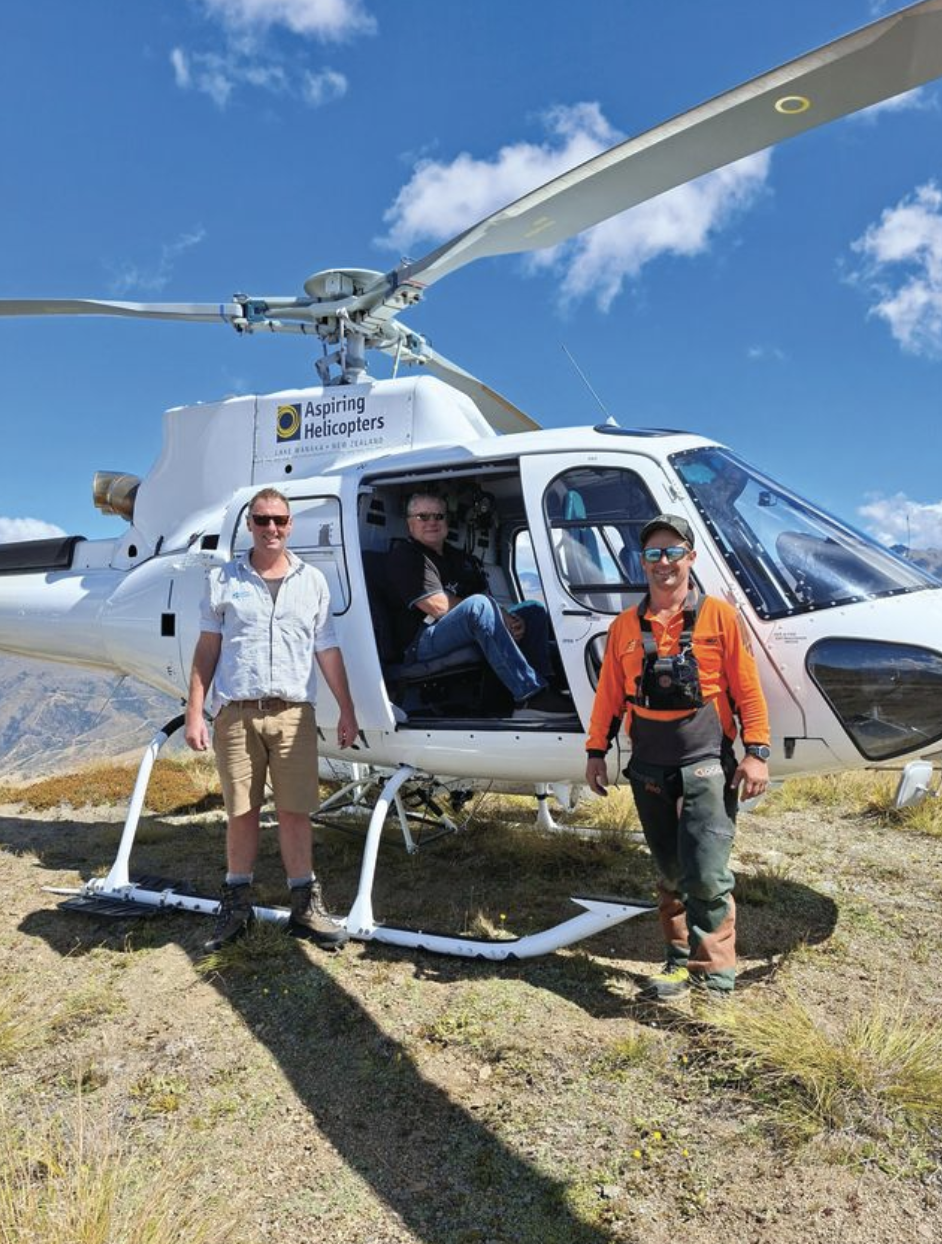
From left, Aspiring Helicopters pilot James Forde; Grant Hensman and Aaron Ford, Central Wilding Tree Control and Landcare Services.
He is calling for an immediate return to sustained national control funding at a consistent level to maintain gains made to date.
Hensman is a long-serving director of Skyline Enterprises and has worked for decades in civil engineering contracting and land development, bringing a commercial lens to environmental issues in the Queenstown region.
He also chairs the local wilding control group and has lived in the district for 65 years, moving from awareness to active leadership as the scale of the challenge became clear.
Hensman argues that wilding pine control is a textbook business case with overwhelming returns.
He argues that government funding cuts below required maintenance levels is squandering prior gains and compounding future costs.
“Control is a simple business case without the emotion associated with some other competing causes for national funding.
“Successive governments have ignored basic business principles.”
Independent economic analyses commissioned by government have reported very high benefit to cost ratios for national wilding control.
One study cited by Hensman describing savings in the billions, yet he says action has moved in the opposite direction.
He points to an Otago analysis indicating a benefit to cost ratio far beyond typical infrastructure thresholds and asks why similar or better public investments routinely proceed while wilding funding stalls.
The urgency is driven by spread dynamics that Hensman describes as compounding at around 30 per cent a year when control lapses, turning containment into an endless and ultimately losing bail-the-boat exercise.
“Why keep bailing the boat for a hundred years when the smart move is to fix the leak?”
Consequences are already visible in the Mackenzie Basin and Waitaki catchment.
The economic stakes for hydropower are substantial because closed canopy wilding forests reduce water yield compared with native or open ecosystems.
Across various science and industry studies the range of potential yield loss is reported from the mid-teens to more than 80 per cent depending on site conditions.
Using a conservative 20 per cent yield reduction applied to the Waitaki scheme’s output, Hensman states a loss equivalent to hundreds of millions of dollars per year in foregone electricity generation, dwarfing the cost of robust wilding eradication.
He notes NZ taxpayers will ultimately fund replacement generation if water yields fall, either through higher power bills or new capital builds, even though prevention is cheaper and faster.
“Government can borrow at low bond rates while the problem grows at thirty per cent a year. Every year of delay raises the final bill,” he says.
Hensman also connects the spread to reputational and direct costs for tourism, a sector he knows from inside the boardroom of a major tourism company.
He warns a fire-prone landscape dominated by closed canopy wildings is the opposite of the brand visitors expect.
He argues that NZ’s celebrated open vistas, accessible biodiversity and seasonal colour are progressively replaced under wilding canopies, diminishing the visitor experience, increasing fire risk, and deterring repeat travel.
“The 100% Pure story collapses if iconic landscapes are overrun and summer skies fill with smoke. Tourism does not thrive in a fire-prone forest.”
He cites historical assurances that wilding spread from earlier state plantings would be contained and says communities downstream of those decisions, including vineyards that rely on irrigation in the Branch and Leatham areas, now face mounting water security risks.
Hensman frames the issue as a choice between smart early investment and unavoidable, larger costs later.
And he challenges decision makers to measure wilding control against the same thresholds applied to roads and other infrastructure that advance when benefit to cost ratios barely exceed one.
He contends that the power sector and central government should co-fund an intensified, sustained programme in high priority catchments to protect hydropower yields, reduce firefighting and suppression costs, and safeguard tourism’s long term value.
First steps are restoring national funding to at least maintenance level, re-establishing coordinated multi-year operations in hotspots, and aligning incentives so that agencies which benefit from water security and brand protection help pay for control.
The NZ Wilding Pine Network annual conference will be held in Invercargill 10-14 August.