
Making gear that actually works on the farm
Words: Jaeden Manufacturing
In New Zealand agriculture, most innovation does not start in a boardroom.
It starts on-farm, with someone trying to solve a problem that’s slowing them down, or thinking, surely there’s a better way to get this done.
The challenge is what comes next.
For many farmers and small agricultural businesses, turning an idea into a working product is harder than it should be.
Offshore manufacturing has its place, but it often requires fully developed designs in the form of a prototype or sample, large minimum order quantities, and long lead times.
That leaves very little room for testing, refining, or adjusting once the product is in use.
And in farming, that matters. There is always a level of trial and error when you put something new in front of hardworking people and ask them to use it day in and day out. If it doesn’t genuinely make the job easier, they will abandon it quickly.
That is where local manufacturing continues to play an important role.
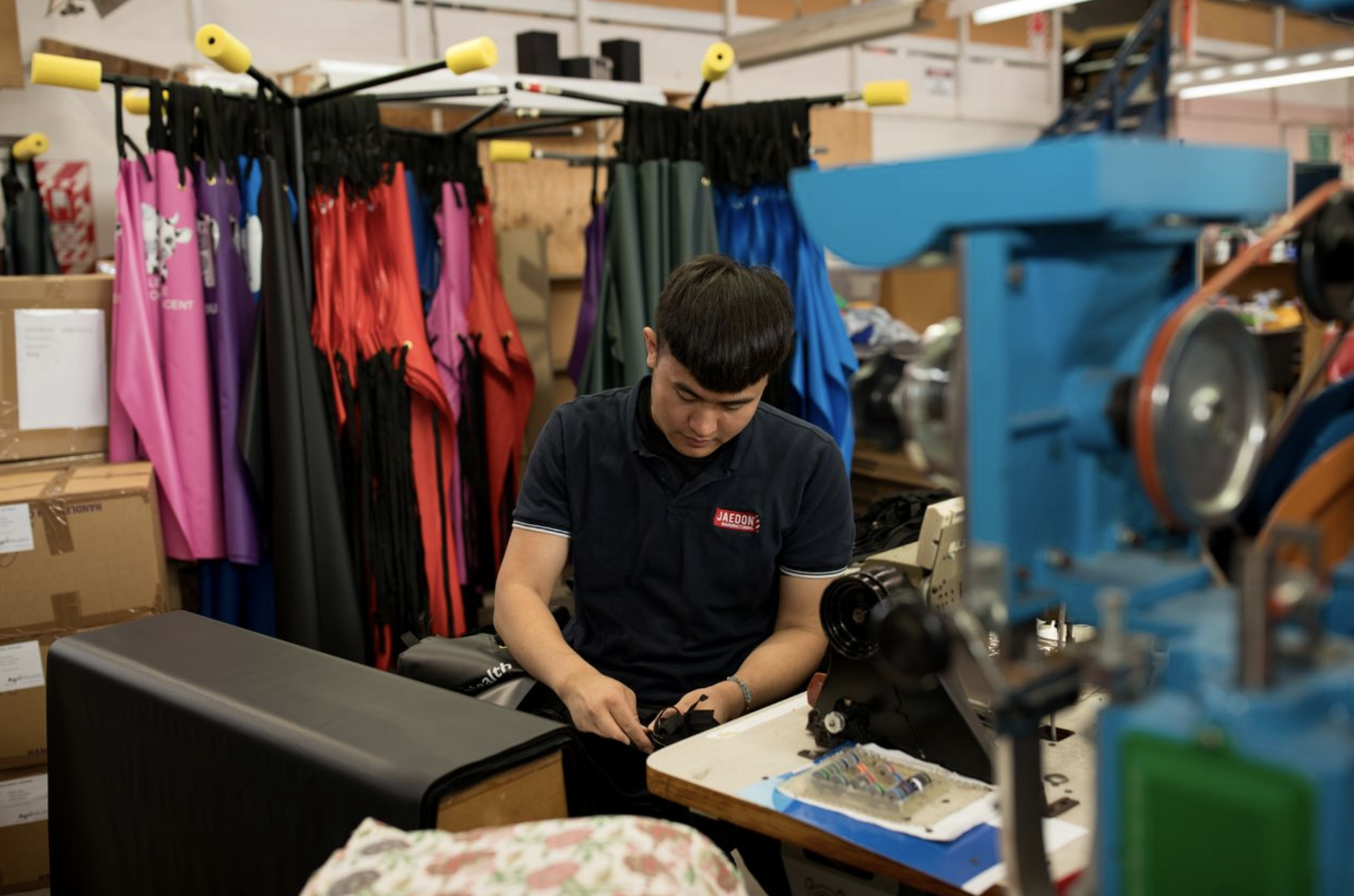
At Jaedon, we manufacture in Manukau, Auckland, and our focus has always been on working alongside people to bring ideas to life, rather than expecting everything to be fully resolved before the process begins. We take the time to understand how something will actually be used, who will be using it, and the conditions it will be exposed to. We use pattern-making software, high-tech cutting machines, and the experience of a highly skilled team.
The goal is not just to make something that works in theory, but something that holds up in practice and becomes part of how the job is done.
A recent example of this approach in action is our work with Robert Holmes from Alleva on the QUADSEAL project.
The formulation itself was already proven, but the challenge sat around the application.
Robert had developed an innovative teat sealant system and an application tool, and what he needed was a practical way for farmers to carry and use that tool efficiently throughout the dry-off process.
It wasn’t simply a case of holding something in place. The belt, holster, and pouch system needed to position the applicator correctly, reduce strain on the body, and allow for a smooth, uninterrupted workflow.
His way of working aligned closely with ours. He was meticulous about getting it right, not just for the sake of the product, but for the person using it.
Getting there required several rounds of development.
Because the work was done locally, those changes could happen quickly, with ideas tested, adjusted and improved without long delays or large commitments upfront.
That ability to produce in smaller runs also made a difference.
That same thinking carries through our broader work in the dairy sector.
Over time, farmers have come to rely on gear that not only meets the requirement on paper, but actually performs in the conditions it is used in.
Durability is part of that, but so is comfort and movement. Materials need to be strong without becoming rigid or restrictive, because if something feels like it is working against you, it won’t stay in use for long. Our aprons are pliable and hardwearing, not sitting around the body like stiff cardboard cut-outs. It’s all in the PVC we use for our trusted Shedline aprons.
We also produce a range of other dairy products, including milking sleeves, traditional dry-off belts and pouches. We are developing ideas in the equestrian field as well.
The reason we continue to manufacture in NZ is simple. Innovation does not happen in isolation. It comes through conversation, through testing, and through working closely with the people who are actually using the product.