
Despite taking nearly a decade, involving several courts and costing millions of dollars, Port of Tauranga’s Stella Passage extension is still going nowhere.
Five Māori organisations have lodged appeals or judicial review applications against the Government’s Fast-track approval granted on 7 September; as of mid-October the Port was planning a vigorous defence and seeking an urgent hearing.
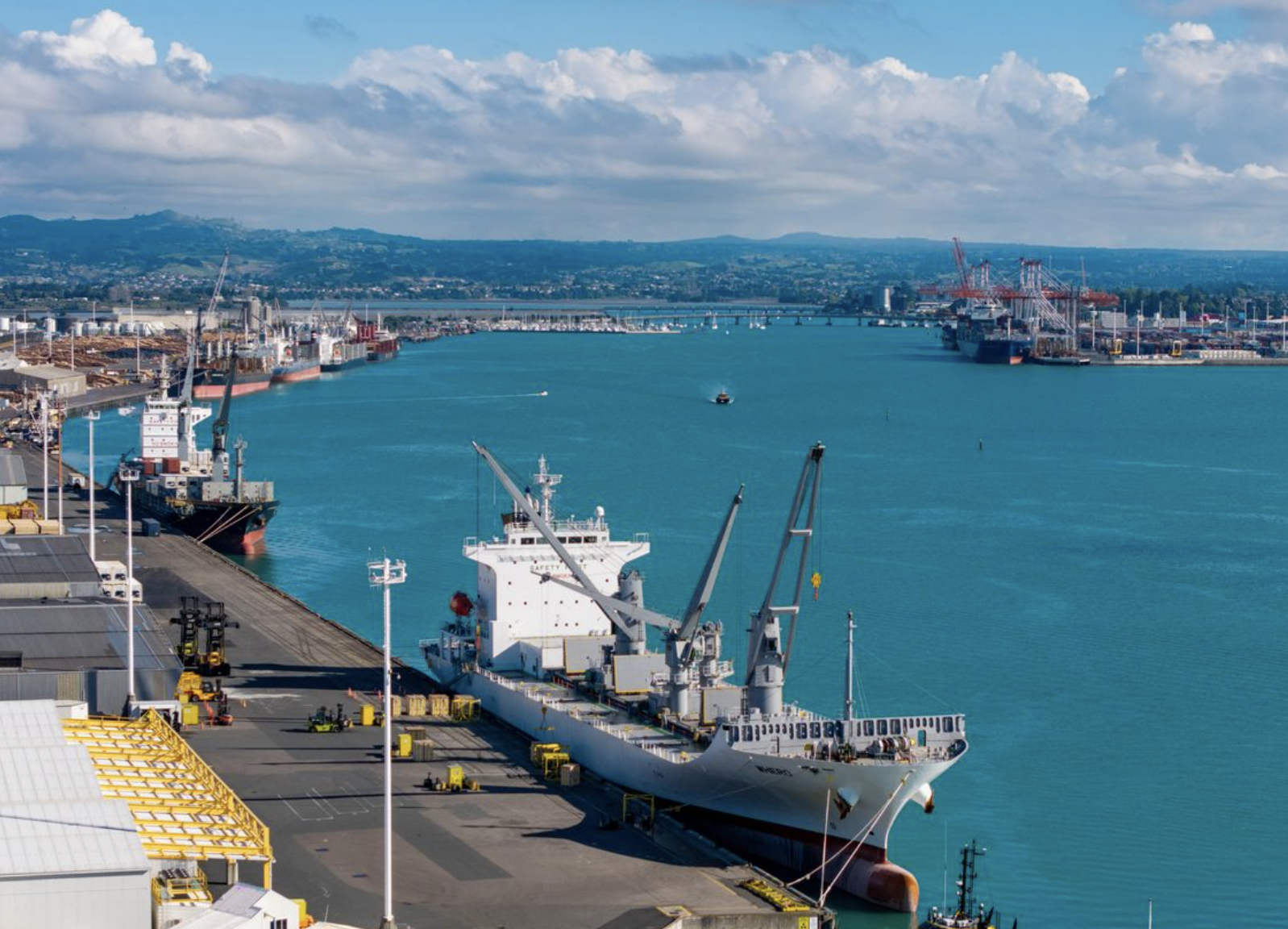
Gateway for 90% of national kiwifruit exports (currently worth $4.3 billion), and 60% of total dairy exports ($28.8 billion), Tauranga is New Zealand’s biggest, most economically valuable port.
The Stella Passage development was first mooted in 2016 to relieve capacity issues that have since only worsened.
Port of Tauranga Chief Executive Leonard Sampson says it is urgently needed, and vital for the regional and national economy.
The port is turning away shipping lines that want to call at Tauranga, including, in 2025, a proposed new service to the Americas he says would have provided New Zealand importers and exporters with an estimated $65 million to $90 million per annum in international freight savings.
New Zealand Institute of Economic Research modelling puts the national one-year opportunity cost of not relieving wharf constraints at $792 million to $1.179 billion in 2033.
The Stella Passage project nearly doubles existing capacity.
It involves extending the Sulphur Point container berth by 385 metres (in two stages) and the Mount Maunganui wharves by 315 metres, by converting existing cargo storage land within the port’s current footprint.
It also involves associated reclamation of the land behind the new wharves and dredging of the passage.
Two of the five organisations currently challenging September’s Fast-track approval (Ngāti Kuku Hapū Trust and the Ngā Tai ki Mauao and Moutere Trust) have opposed the project from the outset.
In evidence filed for the Fast-track process, Ngāti Kuku Hapū Trust and the associated Whareroa Marae sought compensation from Port of Tauranga of $335 to $475 million in present value over 35 years if the development went ahead.
This was to address adverse cultural effects.
However the Fast-track expert panel set that evidence aside, finding cumulative cultural effects could be addressed through an approximately $6 million mitigation package included in conditions of the approval, to be paid by the Port.
This package includes $2 million for harbour health projects, administered by the iwi/hapū forum Stella Passage Development Advisory Group; and $1 million for marae infrastructure, plus $25,000 a year, paid to the Whareroa Marae Reservation Trust.
Both Ngāti Kuku Hapū Trust and the Ngā Tai ki Mauao and Moutere Trust are now seeking judicial review of the approval.
They succeeded in a similar High Court action against the Environmental Protection Authority last year, which meant Port of Tauranga had to re-submit its application.
Three other parties currently oppose September’s approval on points of law which as yet remain unknown: Ngāi Te Rangi Settlement Trust, Ngāti Pūkenga and a group comprising Ngāti Ranginui Iwi Society Inc; Ngāti Ranginui Settlement Trust and Ngāti Ranginui Fisheries Trust.
In its official letter of support for the project to the Fast-track panel, Fonterra’s Director, Global Supply Chain, Santiago Aon, described Port of Tauranga as ‘critically important’ to the co-op’s export business, handling about 130,000 twenty-foot equivalent unit (TEU) containers a year.
Zespri CEO Jason Te Brake told the panel the port is the cornerstone of New Zealand’s kiwifruit export system.
“Without extra berth capacity, there is a material risk that [it] will be unable to accommodate larger, more efficient vessels, increasing the likelihood that New Zealand becomes a feeder origin for transhipment through Australian ports.”
Port of Tauranga has so far paid more than $1.7 million for iwi legal and cultural advice related to Stella Passage.